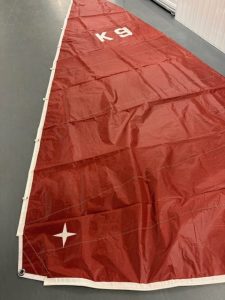
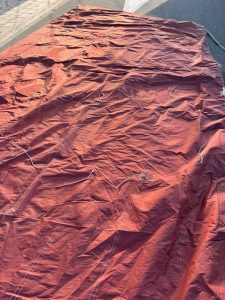
Definition and key measurements
The mainsail fills the main triangle bounded by mast, boom and tack. Standard dimensions:
P = luff length (mast track from boom to black band)
E = foot length (boom from mast to black band)
Roach = extra curve beyond the straight line from head to clew
Area = (P × E) / 2 + roach allowance
Girths (MGUM, MGM, MGU) control shape when reefed.
Mainsail categories
Full-batten mainsail
Horizontal battens span clew to luff
Zero flutter, maximum projected area
Requires lazy-jacks or Dutchman for flake control
Ideal for performance cruisers and racers
Typical roach 12–18 %, supported by 5–7 full battens
Partial-batten mainsail
3–4 short battens at upper leech only
Easier to hoist and flake by hand
Moderate roach (8–10 %)
Standard on boats under 30 ft or charter fleets
In-mast furling mainsail
Vertical battens or none; zero roach
Rolls inside mast via continuous-line furler
Infinite reef points, single-line cockpit control
Trade-off: 15–20 % less drive than battened mainsail
Cloth: vertical-cut Dacron or hydra-net for roll stability
Storm trysail
Separate sail, bright orange, 15–25 % of working mainsail area
Set on dedicated trysail track parallel to mast
Deep third reef replaces trysail on modern rigs
Required for World Sailing OSR Category 0/1
Procurement and upcycling
Send P/E measurements to info@resail.org for a matched second-hand mainsail or to arrange free collection of your retired sail. Every exchange keeps 20 m² of technical textile in circulation.


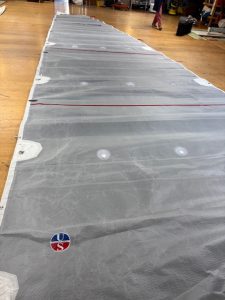
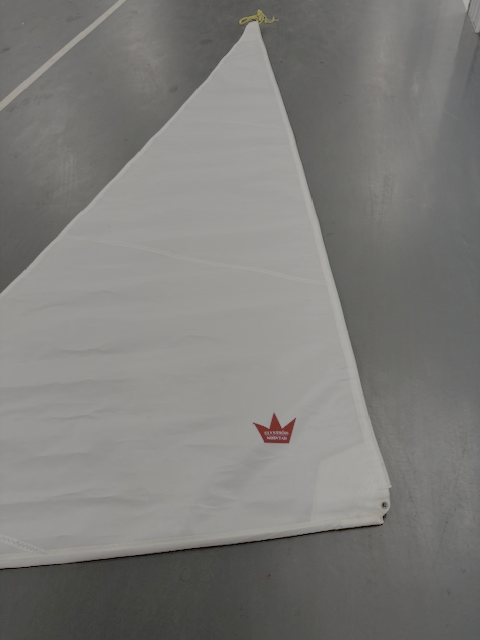
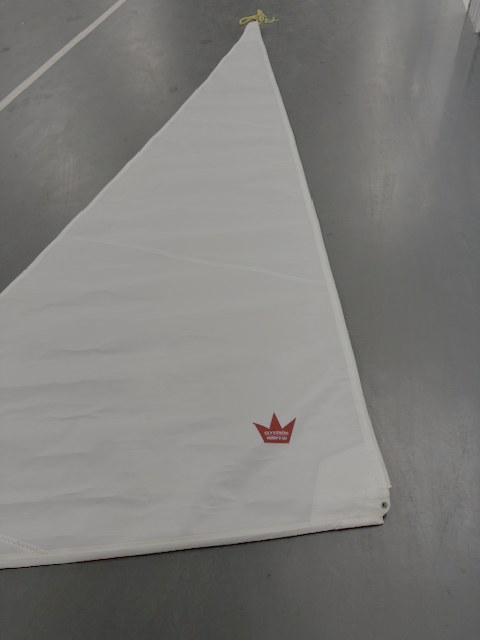
 Sail Area: 31.76m2
 Luff: 11.05m
 Foot: 3.82m
 Leech: 11.60m