


Finally you are bearing away. The sheets ease, the boat sits up and the question comes up: which sail do you set now? A Code 0, a halfwinder, a gennaker, a spinnaker or a passage sail? When you bear away, your best sail choice depends on four things: your wind angle, the wind strength, the size of your crew, and whether you want pure speed, easy handling or long-distance durability.
In this guide we compare the five most common off-the-wind sails, so you can see which one suits your boat and your way of sailing. Looking for one right away? Browse our used downwind sails.
| Sail | Wind angles | Rigging | Best for |
|---|---|---|---|
| Code 0 | 50° to 120°, light to moderate wind | Top-down furler, straight luff | Light-air reaching, easy furling |
| Halfwinder | Beam to broad reach, light to medium air | Set flying or on a furler | Relaxed cruising on a reach |
| Gennaker | 90° to 160° TWA | Bow or bowsprit, no pole | Fast reaching, short-handed crew |
| Spinnaker | 100° to 180° TWA | Pole, guy and sheet | Dead runs, full-crew racing |
| Passage sail | Reaching and downwind | Durable, predictable shape | Multi-day and offshore passages |
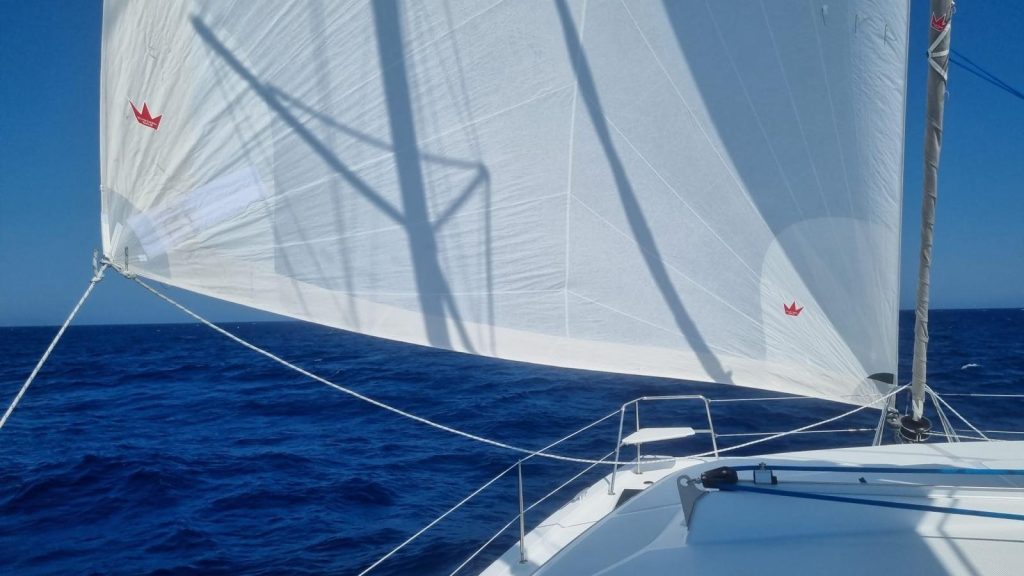
A Code 0 bridges the gap between your genoa and a gennaker. It has a flat cut with a straight luff and is typically flown on a top-down furler with an anti-torsion cable. Its range runs from a tight reach to a broad reach, roughly 50° to 120°, and it is at its best in light to moderate wind.
Choose a Code 0 if the wind is light to moderate and you want to crack off the wind (close or beam reach) with strong power, especially if you want push-button furling convenience from the cockpit. See our used Code 0 sails.
A halfwinder is a lightweight, all-purpose reaching sail. It is often set flying, on a furler or as a cruising reacher, and it works best from a beam reach to a broad reach in light to medium air. It is smooth and forgiving, so you cover effortless off-the-wind miles without constant trimming or spinnaker pole work.
Choose a halfwinder if you are cruising on a reach and want a friendly, easy-going sail that adds speed and comfort without the complexity of a traditional spinnaker or gennaker setup.

Gennakers and spinnakers are both large, light sails for off-the-wind sailing. The main difference is the shape and the way they are flown. A gennaker is asymmetrical and needs no pole. A spinnaker is symmetrical and is flown from a spinnaker pole. That difference decides which wind angles they cover and how much crew work they ask.
The gennaker is asymmetrical, with its tack on the bow or a bowsprit, so no spinnaker pole is required. It covers a beam or broad reach to a deep reach, roughly 90° to 160° TWA. It is easy to set, gybe and douse, especially with a snuffer or furler, which makes it a good fit for a short-handed crew. On reaching angles it gives great speed.
Choose a gennaker if you want fast, fun reaching and deep-reaching angles with a small or cruising crew and prefer not to deal with a spinnaker pole. Browse our used gennakers.
The spinnaker has a symmetrical balloon shape and is flown with a spinnaker pole, a guy and a sheet. It works from a broad reach to dead downwind, roughly 100° to 180° TWA. It gives maximum downwind power and can sail a dead run, which is why it shines when sailing straight downwind and in full-crew racing and offshore runs.
Choose a spinnaker if you are heading deep downwind (near 160° to 180°), where an asymmetrical sail would be blanketed behind the mainsail, or if you want maximum downwind drive and have the crew and gear to manage the pole and gybes. Browse our used spinnakers.
A passage sail is made for reaching and downwind passages. The exact design varies, for example a cruising reacher or a downwind sail, but the idea is the same: durability, a predictable shape and manageable handling over long miles. It prioritises longevity, stability in shifting gusts and seas, and easy control over peak racing angles.
Choose a passage sail if your priority is multi-day or offshore cruising reliability, conservative cloth and construction, and steady, low-stress handling rather than squeezing out every tenth of a knot.
Downwind sails can be a significant investment, which makes a used or pre-owned sail an attractive alternative. Before you buy, check what your boat is equipped with: a bowsprit or tack point for an asymmetrical sail, or a spinnaker pole and sheet arrangement for a symmetrical one. Ask yourself how experienced you and your crew are, and whether you mainly sail downwind or also want to reach.
When you inspect a used spinnaker or gennaker, look closely at the seams and corners, which endure the most stress, and check for sun damage. Compare the dimensions with your boat as well. Every sail on Resail lists its sail area, luff, foot and leech, together with the producer and condition. More tips are in Buying used spinnakers and gennakers and Biggest mistakes when buying used sails. Thinking of a race sail for cruising? Read Are used racing sails suitable for cruising?
Whether you go for a Code 0, a halfwinder, a gennaker, a spinnaker or a passage sail, a used sail gives you the performance you are looking for at a fraction of the price of a new one. Browse all downwind sails on Resail and find the one that matches your boat.
Resail, there is always a second life for sails!